Last week the final Paideia seminars took place for the Year 5&6 and Year 7&8 Extension groups. The Y5&6 seminar took place on Tuesday afternoon and the Y7&8 seminar took place the following morning on the Wednesday.
The provocative statement put to the students was: 'The Arts are just as important as academic subjects'. It was quite interesting to hear their viewpoints based on this provocative statement. Many decided that academic subjects such as reading and maths were more important than the arts. Some argued that reading is the most important subject because it helps with all subjects. Some said that the arts should be optional. Others said that the arts are important for giving students who are not good at reading or maths the chance to express themselves. The variety of opinions was interesting. There was no dominant thinking (agree or disagree) towards or against the statement.
I was impressed with the way in which the Year 5&6 students were engaged with the discussions. Most students were able to express their thoughts and opinions with the group. Most were able to build on the ideas of others which demonstrated that they were actually listening to what was being said.
It was a different story with the Year 7&8 group. It was quite difficult to get half of the group to engage properly with the discussions. Quite a few were reluctant to share. I think that I made the mistake of holding the seminar in class. There were no stand alone tables so the students sat on their chairs facing each other. The students had also completed quite a complex task before hand, so in hindsight it was probably not a good idea to hold our seminar straight after.
Overall, I am happy with the way that the Paideia seminars have panned out. We didn't have any in Term 1 due to the lack of time and due to our FiaFia event. I do feel that it's still something that needs to be pursued next year because it does give our students the chance to improve their critical thinking skills and communication skills.
Showing posts with label Inquiry 2018. Show all posts
Showing posts with label Inquiry 2018. Show all posts
Monday, 10 December 2018

Monday, 20 August 2018
Inquiry Reflection - Term 2 Paideia Seminar results
Inquiry Reflection
Towards the end of Term 2 both extension groups participated in a Paideia Seminar. The seminars were filmed and then I analysed how well the students participated during the seminars.

This is a graph that shows the Year 5&6 Extension group results. There were only 3 students who spoke at least 10 times or more. There were 8 students who spoke between 5-10 times. Four students spoke less than 5 times and three students were away. The more confident students tended to contribute more ideas and were able to elaborate on what they were saying.

Here is a graph of the Year 7&8 Extension students participation from their Paideia Seminar last term. One student dominated the conversations with more than 15 talk times. Another student who was also quite confident spoke more than 10 times. There were 8 students who spoke between 5-10 times. Five students spoke less than 5 times and two students were away. The students who spoke the most tended to be very self-confident and articulate. This was in contrast to the shy students who needed to be prompted to share.
This is the second year that I have been using Paideia Seminars to encourage students to think and to communicate clearly with others. Once again the confidence of the student makes a big difference in whether or not they participated effectively, regardless of whether they researched their inquiry topic effectively or not.
Next steps: To focus on helping the shy students use effective strategies to help them to prepare well and to share their ideas. To encourage the shy students to contribute more often in the next Paideia seminar at the end of the term.
Towards the end of Term 2 both extension groups participated in a Paideia Seminar. The seminars were filmed and then I analysed how well the students participated during the seminars.

This is a graph that shows the Year 5&6 Extension group results. There were only 3 students who spoke at least 10 times or more. There were 8 students who spoke between 5-10 times. Four students spoke less than 5 times and three students were away. The more confident students tended to contribute more ideas and were able to elaborate on what they were saying.

Here is a graph of the Year 7&8 Extension students participation from their Paideia Seminar last term. One student dominated the conversations with more than 15 talk times. Another student who was also quite confident spoke more than 10 times. There were 8 students who spoke between 5-10 times. Five students spoke less than 5 times and two students were away. The students who spoke the most tended to be very self-confident and articulate. This was in contrast to the shy students who needed to be prompted to share.
This is the second year that I have been using Paideia Seminars to encourage students to think and to communicate clearly with others. Once again the confidence of the student makes a big difference in whether or not they participated effectively, regardless of whether they researched their inquiry topic effectively or not.
Next steps: To focus on helping the shy students use effective strategies to help them to prepare well and to share their ideas. To encourage the shy students to contribute more often in the next Paideia seminar at the end of the term.
Monday, 9 July 2018
Y7&8 Extension group Paideia Seminar - Term 2
Here are some snippets from the Year 7&8 Paideia Seminar held in Term 2. The theme was flight and the provocative statement that was put to the students was: 'Developing new technologies may be the only way to ensure the survival of the human race.' Here are just some of their ideas regarding this idea and their ideas around 'Flight'.
Friday, 6 July 2018
Y5&6 Extension group Paideia Seminar - Term 2
Here are some snippets from the Year 5&6 Paideia Seminar held in Term 2. The theme was flight and the provocative statement that was put to the students was: 'Developing new technologies may be the only way to ensure the survival of the human race.' Here are just some of their ideas regarding this idea and their ideas around 'Flight'.
Wednesday, 17 January 2018
Apple Women Leading Learning: Coding Summer School Day 1

The Apple coding workshop was held at the UTS (University of Technology Sydney) building in Sydney. We started with a presentation about why we should teach coding.
Coding inspires creation. It’s about harnessing the power and put into hands of students
We briefly looked at the Swift Playground app and met some of the Apple presenters.
Apple Education and Girl Geek Academy
Why teach coding?
Coding is a learnable skill, Jobs and careers, To change the world, Empowerment
Coding is a learnable skill, Jobs and careers, To change the world, Empowerment
Very often there are incredible gains to be made from technology.
We are expert users of programmes that someone else has written - people doing
programming were actually holding power over what we do.
programming were actually holding power over what we do.
Coding provides opportunities for people to create own apps and programmes
Students need opportunity to create their own programmes/apps
Focus of workshop: how to become great leaders in delivering coding programme
How to deliver/sell importance of programme to school and staff
Girl Geek - Sarah CEO
Female leaders
She-Hacks - female only hackathon
MissMakesCode
SheMakesGames

Barriers for women in tech
Women are not recruited as much
Women have access to fewer resources
Girls are not encouraged to enter STEM subjects
Gender equality problem
Attitudes are a barrier
Under representation of girls in IT jobs
Influence of parents
Teacher gender biases
Career advice
How to change this?
Building self efficacy in girls
Use of positive language to build confidence in girls
Use of positive language to build confidence in girls
Women tend to underestimate their skills compared to men
Sphero: can be programmed to respond in a unique environment
Computational participation - capacity to work collaboratively, explain ideas and
thinking with other people
thinking with other people
Ways of thinking with Sphero
How does it impact on what we are about to undertake?
Value of activity in real world?
3 Types of Thinking:
Design Thinking
Computational Thinking
Systems Thinking
Practiced using Sphero and ipad in small groups of 3-4
Increasing speed = further distance because of velocity
Purpose: why use sphero? Connect its relation to real world/industry

Sphero
Wait = length of time ball rolls in direction set previously
Stop = ball fully stops to allow for the sharp turn/angle
What is Swift? Easy to use, Interactive, Powerful, Open-source
Building lessons/tutorials
Swift Playgrounds (Lou and Michelle)
Before using spheros, need to have a foundation so don’t use as a starting point for kids.
Suits students between 11-15 years of age.
Moving beyond block based coding, lots of primary schools using Scratch
Swift playgrounds sits in between block based programming and XCode - app depth
What app would you create if you could create an app?
Coding language is unpacked through learning to code 1 module
Common language
Do learning to code 1 before trying ‘challenges’
Accessories - more games to try
Accessibility tool - turn on speaker/voice for sound for kids with poor English/low reading
age (settings, general, accessibility, speak selection and speak screen)
age (settings, general, accessibility, speak selection and speak screen)
Learn to Code 1&2 Teacher Guide:
Y6-8
45 hrs of lessons
Macarena example
Who knows a dance?
How is this related to functions and loops?
Look at important vocab - put up on wall to display
Get kids to write up what they think word means
Startups with Sara (Girl Geek Academy)

Startups are about growth, scalable solutions - very big user audience e.g. airbnb,
instagram etc
instagram etc
Hacker - person who can code, engineer (computational thinking)
Hipster - Make things look good (design thinking)
Hustler - Make things happen, makes sure business can flourish, (systems thinking)
These qualities fit into the digital technology part of the Australian curriculum. In NZ there
is more of a focus on computational thinking and design thinking (I think)
is more of a focus on computational thinking and design thinking (I think)
Tuesday, 16 January 2018
Apple Women Leading Learning: Coding Summer School
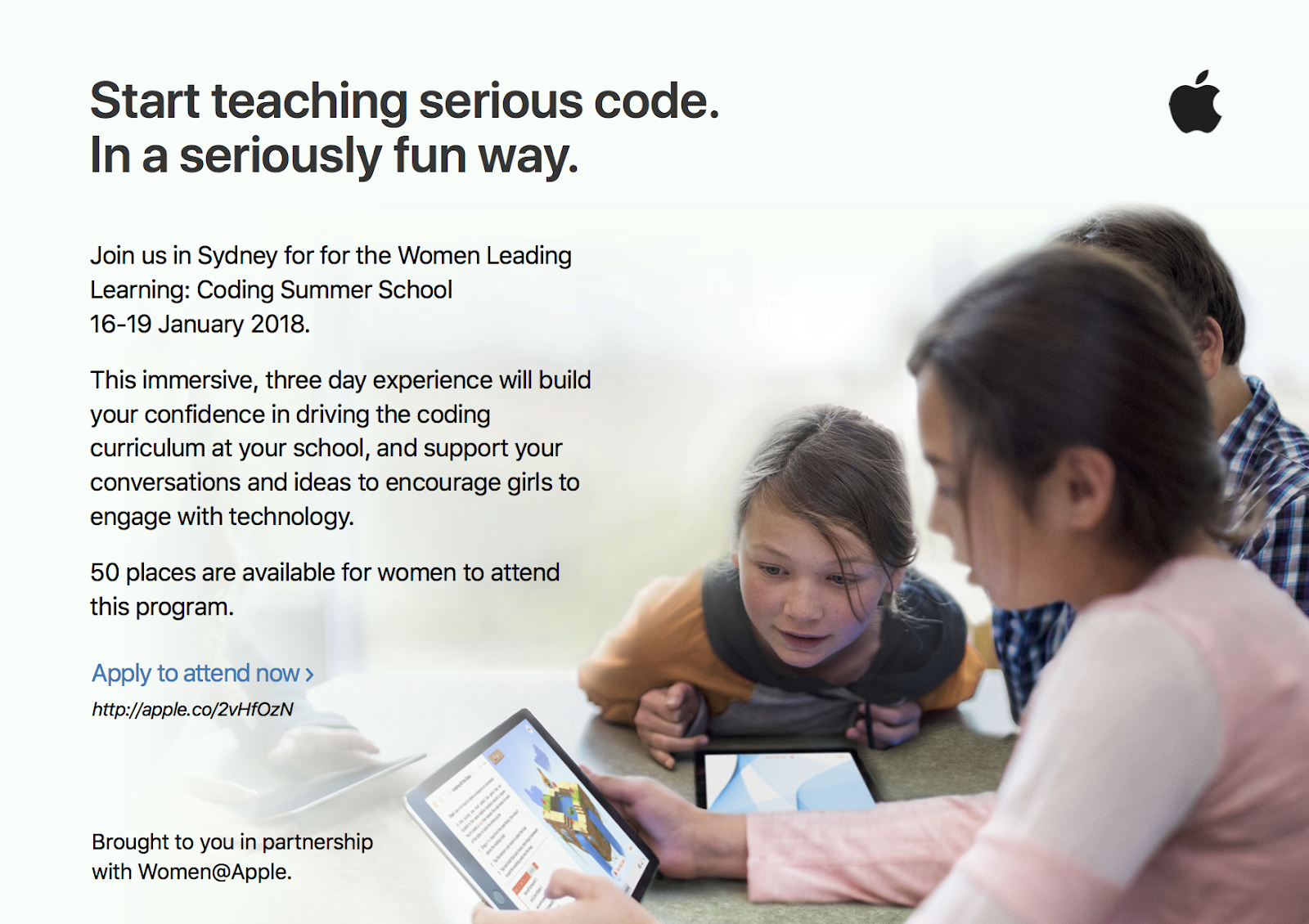
I was given the amazing opportunity to attend the Apple Women Leading Learning:
Coding Summer School in Sydney during the School holidays. I applied sometime during
March of 2017. I received confirmation that I had been accepted at the end of Term 3 of
2017. This was an exciting opportunity to find out more about coding with Swift Playgrounds.
Coding Summer School in Sydney during the School holidays. I applied sometime during
March of 2017. I received confirmation that I had been accepted at the end of Term 3 of
2017. This was an exciting opportunity to find out more about coding with Swift Playgrounds.
I arrived in Sydney on Tuesday 16th January 2018. I met with my roommate Sylvie from
Ormiston Junior College in Auckland. Apparently there were only 4 women from NZ
attending and the rest were teachers from across Australia. That evening the entire group
met for the first time at the Apple Headquarters in Sydney. We also got the chance to
meet with the amazing women involved in organising this event. A few key people from
Apple delivered a presentation about Apple products and talked about how students are
being taught how to code and create apps. Later in the evening we all got the chance to
mix and mingle and meet all the other teachers who were invited to be part of this program.
Ormiston Junior College in Auckland. Apparently there were only 4 women from NZ
attending and the rest were teachers from across Australia. That evening the entire group
met for the first time at the Apple Headquarters in Sydney. We also got the chance to
meet with the amazing women involved in organising this event. A few key people from
Apple delivered a presentation about Apple products and talked about how students are
being taught how to code and create apps. Later in the evening we all got the chance to
mix and mingle and meet all the other teachers who were invited to be part of this program.
Subscribe to:
Posts (Atom)