Showing posts with label Year 5 & 6 Extension. Show all posts

Monday, 21 October 2019

Inquiry Update - Week 2 Term 4


What? How to improve oral language and critical thinking skills
Why? Extension group, but still need to be able to express themselves intelligently and with confidence. To extend their thinking skills.
How? Paideia Seminars, rich experiences, links with theme for the Term
End of Term 3: Y5&6 completed Stop Motion movies, x2 Paideia Seminars

Focus for Term 4: Science focus on the Physical World. Researching info about UV light and its effects on our skin and on the Earth. Skin cancer and Global Warming/Climate Change. Making UV sensors with Ray Shah (scientist). KPMG Trip focus: Dance and Drama theme - Pop Up Globe theatre.

Friday, 27 September 2019

Inquiry Update - Week 10, Term 3

Extension Group Reflection snapshot - End of Term 3, 2019


Year 5&6 Extension:

Museum Trip over 2 days. Focus was on exploring digital technologies. VR experience was enjoyable for students. Based on ‘Something in the Water’ Inquiry theme - creating a Rocky Shore ecosystem. Coding with Dash robot - recording information about sea creatures and playing back during coding.
Stop Motion DLO’s being created - based on a theme around water or the ocean.
Film Festival movie created - students collaborated to create the script and plot for the movie. 
One movie created for 'The Outlook for Someday' competition. 
x2 Students featured in Kea Kids News on HeiHei website (Episode 6).
Term 3 Paideia Seminar.

Year 7&8 Extension:

Created movies about sustainability as DLO (Digital Learning Object) for the term.
Film Festival movie created - collaborated to create script and plot.
x2 Students featured in Episode 5 of Kea Kids News on HeiHei website. 
Term 3 Paideia Seminar

Thursday, 26 September 2019

Example of student research task: Year 5


Students were put into small groups of three. Each group had to research information related to the theme for the term. This group was asked to research from the point of view of a 'Scientist'. Other groups included the 'Conservationists, Environmentalists, Teachers, Eels and Maori Tribe.' The students were asked to look at each issue from the perspective of their group name e.g. Maori or Conservationist. This would provide an interesting point of view or point of argument during the Paideia Seminar.

Saturday, 4 May 2019

Year 5&6 Paideia Seminar Term 1

The first Paideia Seminar for the Year 5&6 Extension group was held last week. It was postponed last term due to some students being involved in sports championship playoffs. The topic was around the theme of Eels, Maramataka (Maori Lunar Calendar) and the issue of pollution.

The outcome was typical of past experiences. The students were shy to share ideas at the start. They Year 5 students were more reluctant than the Year 6 students who had a year of experience in comparison.


Half of the Year 5 group only spoke once with some prompting and encouragement. A couple of Year 5s spoke more than 5 times. The Year 6 group were more confident and dominated the conversations.

Most responses consisted of the students responding to a question that was asked by the teacher. Only in the second half of the seminar did the students tend to piggy back off the ideas of others and begin to expand on their own statement.


Next steps: 
- Provide strategies and opportunities for the Year 5 students and some of our Year 6 students to build their confidence and increase their level of participation.
- Provide more resources and tasks around speaking, listening and thinking e.g. more tasks where students have to research a topic and then present to the class.


Thursday, 14 March 2019

Year 5&6 Extension visit to Eel tank with Mr Vogt

The Year 5&6 Extension group was very lucky to have visits from two eel experts Dave Cooper and Mahu (Ngati Paoa) this term. We are grateful to Mr Vogt for organising these visits as it relates to our inquiry for the term. Mr Vogt was also present for both visits to introduce our guests and to help direct student learning. The visit to our school eel tank was definitely a highlight for the Extension group.

This movie shows highlights from the Year 5&6 Extension group visit to the eel tank for the second time this term with Mr Vogt and Mahu.

Tuesday, 5 March 2019

Year 5&6 Extension visit from Dave Cooper

The Year 5&6 Extension group had the privilege of having eel expert Dave Cooper visit us during the week. Dave shared his knowledge about Longfin Eels and how they migrate over long distances (Pacific Ocean near Tonga) to spawn before dying. The students had the opportunity to ask lots of questions and found out some interesting information about eels.


Monday, 10 December 2018

Final Inquiry Reflection 2018

Last week the final Paideia seminars took place for the Year 5&6 and Year 7&8 Extension groups. The Y5&6 seminar took place on Tuesday afternoon and the Y7&8 seminar took place the following morning on the Wednesday.

The provocative statement put to the students was: 'The Arts are just as important as academic subjects'. It was quite interesting to hear their viewpoints based on this provocative statement. Many decided that academic subjects such as reading and maths were more important than the arts. Some argued that reading is the most important subject because it helps with all subjects. Some said that the arts should be optional. Others said that the arts are important for giving students who are not good at reading or maths the chance to express themselves. The variety of opinions was interesting. There was no dominant thinking (agree or disagree) towards or against the statement.

I was impressed with the way in which the Year 5&6 students were engaged with the discussions. Most students were able to express their thoughts and opinions with the group. Most were able to build on the ideas of others which demonstrated that they were actually listening to what was being said.

It was a different story with the Year 7&8 group. It was quite difficult to get half of the group to engage properly with the discussions. Quite a few were reluctant to share. I think that I made the mistake of holding the seminar in class. There were no stand alone tables so the students sat on their chairs facing each other. The students had also completed quite a complex task before hand, so in hindsight it was probably not a good idea to hold our seminar straight after.

Overall, I am happy with the way that the Paideia seminars have panned out. We didn't have any in Term 1 due to the lack of time and due to our FiaFia event. I do feel that it's still something that needs to be pursued next year because it does give our students the chance to improve their critical thinking skills and communication skills.

Monday, 20 August 2018

Inquiry Reflection - Term 2 Paideia Seminar results

Inquiry Reflection

Towards the end of Term 2 both extension groups participated in a Paideia Seminar. The seminars were filmed and then I analysed how well the students participated during the seminars.


This is a graph that shows the Year 5&6 Extension group results. There were only 3 students who spoke at least 10 times or more. There were 8 students who spoke between 5-10 times. Four students spoke less than 5 times and three students were away. The more confident students tended to contribute more ideas and were able to elaborate on what they were saying.


Here is a graph of the Year 7&8 Extension students participation from their Paideia Seminar last term. One student dominated the conversations with more than 15 talk times. Another student who was also quite confident spoke more than 10 times. There were 8 students who spoke between 5-10 times. Five students spoke less than 5 times and two students were away. The students who spoke the most tended to be very self-confident and articulate. This was in contrast to the shy students who needed to be prompted to share.

This is the second year that I have been using Paideia Seminars to encourage students to think and to communicate clearly with others. Once again the confidence of the student makes a big difference in whether or not they participated effectively, regardless of whether they researched their inquiry topic effectively or not.

Next steps: To focus on helping the shy students use effective strategies to help them to prepare well and to share their ideas. To encourage the shy students to contribute more often in the next Paideia seminar at the end of the term.

Friday, 6 July 2018

Y5&6 Extension group Paideia Seminar - Term 2

Here are some snippets from the Year 5&6 Paideia Seminar held in Term 2. The theme was flight and the provocative statement that was put to the students was: 'Developing new technologies may be the only way to ensure the survival of the human race.' Here are just some of their ideas regarding this idea and their ideas around 'Flight'.

Friday, 24 November 2017

Term 4 Paideia Practice with Y5&6 Extension group

Y5&6 Paideia practice Term 4 2017 from SchoolTV on Vimeo.

This terms theme is 'Musical Madness' with a focus on music and making music. The year 5 and 6 extension group practiced their thinking, speaking and listening skills through a Paideia practice session. They were encouraged to share their thoughts and opinions as well as piggy back off the ideas of others.

Most students participated well. Compared to Term 1, the students have a better understanding of how to be considerate of others, and how to wait for others to share their ideas especially if they have already spoken. Most are now more confident to share and express themselves during the group discussion. They are more focused and now put more thought into their answers. I am really proud with how far they have come.

Friday, 22 September 2017

3rd Paideia Seminar Reflection

On Tuesday the Year 5 & 6 Extension students had their third Paideia Seminar for the year. The provocative statement was: ‘Is being civilised such a good thing?’ The statement was kept quite general and broad so that the students had the opportunity to take their thinking in many different directions. One of the discussions was about the idea that the advancement of technology was actually the cause of many of the problems that society now faces. Another was about the possibility of living on another planet.

The seminar provided opportunities for students to talk about the school wide theme: Guardians of the Galaxy. They have been learning about space exploration and the basic elements necessary for life e.g. soil, sun and water. In extension class they have been exploring the possibility that humans may need to physically adapt to survive on other planets.

Once again tokens (lollies) were provided on each table to encourage our speakers to participate and also remind them that they need to share an idea at least three times. Our less confident speakers were given cue cards to prompt them. Their names were also put onto the whiteboard and ticks were put next to their names after each time they spoke.

The idea was that this was going to be a collaboration and that students would participate equally and fairly. Less confident students were supposed to be encouraged to share. However things didn’t quite work out as planned. The same students tended to dominate much of the conversation and had to be asked to wait for others to speak first towards the end of the seminar. One of our less confident students declined the offer to speak and share an idea at one stage which was disappointing. Students also had to be reminded to connect with other ideas that were shared or to piggyback and acknowledge what was previously said.

The highlight was that a student who had been very reluctant to share ideas in the last two seminars was surprisingly one of the students who tended to dominate talk time during this seminar.

Next steps:
  1. Continue to encourage the less confident students to participate more often. Next time these students might need some written statements handy to read out during discussions just to practice speaking in front of their peers in this type of situation more often.
  2. The more dominant speakers may need cue cards to remind them what they can do to support others who have not participated enough.
  3. Keep providing practice conversations/scenarios for students to practice piggybacking off the ideas of others, to extend their explanations and to think more deeply about what they are saying.

Monday, 14 August 2017

Inquiry Findings - Term 3 Week 4


For this group inquiry meeting we had to share what were were up to so far in terms of our inquiry and inquiry findings. I shared snippets of our first Paideia Seminar and my analysis of it using SOLO as a framework. I replayed footage of the seminar to analyse the different types of student responses. This was plotted onto a graph and the totals were added up against each child and their responses.

From there I could then create a bar graph to view the results visually. It was very interesting to see specifically who dominated the talk time and who did not participate much. The data enabled me to identify students who needed extra support.

The Year 5 & 6 Extension group will be exploring the idea of how the human race might adapt as a species in order to survive on other planets. Our Year 7 & 8 students presented two great workshops at this years GEGNZ Student Summit held at Ormiston Junior College.

Thursday, 27 July 2017

Second Paideia Seminar Reflection

Paideia Seminar Term 2: Year 5 & 6 Extension

Today we held our second Paideia Seminar for our Year 5 & 6 Extension students. The students had plenty of support during the lead up to this seminar. Throughout term they continued to practice how to disagree agreeably, listen to what others had to say and think about how to share their ideas based around an issue. The main topic was based around our school wide theme for the term - ‘Now That’s Thinking’ and about the impact of technology on our lives.

During the term the students practiced arguing their point of view about an issue. Once again we were lucky to have the guidance and support of Anne Sinclair who helped throughout the term. The main task in Term 2 was to create a mini production. The students were put into 5 main groups: Script writers, set/background designers, dancers, costume designers, and light and sound team.

Each team collaborated and contributed to the creation of the production. They also researched about an aspect relating to their group focus e.g. history sewing machines, dancing, and set designs. They began to see how the development of innovative technologies has changed the way things are done over time e.g. digital technology now means that music and set designs can now be digitally created. The students then participated in the mini production in front of the school at the end of the term.

Today’s panel discussion was the culmination of the students research and work around the issue of collaboration and technology. Once again a room was setup to create the atmosphere of a conference. Students in each group received lollies as a form of token. Each student could eat a lolly once they had shared their thoughts. Everyone was encouraged to speak, share and respond.

I noticed that the students were quite shy to begin with. Further into the seminar the students began to gain confidence and were more willing to participate and speak up. One student in particular needed to be reminded to let others speak as this person tended to dominate the conversations.

Overall I think that the seminar was very successful. I am proud of what the students have achieved. It reinforced the knowledge that we have some very bright students in this group. However a couple of students still need to learn how to listen and give others a chance to share. A few students also need to be more prepared, or have more courage to share their ideas.

Our reflection will look at:
  1. How are we going?
  2. What worked well?
  3. Where are we going?  
  4. What could we improve?
  5. Where to next?

For a first time in Stage 1 of the Paideia Seminar the students did so well. We can ask them these questions as well and also what they would like to see and what ‘rules’ we could use, eg:
  • Only one person talks at a time
  • Respect the speaker
  • Give others a chance to speak
  • Look at the person you are talking to or asking a question of
  • Say their name when you ask them a question or challenge an idea
  • Be supportive of others and help them to participate
  • Be prepared
  • Expand on the discussion ideas next time using the prompts
  • Extend the discussion

Wednesday, 19 July 2017

Back in da Day Reflection

The production was performed on Tuesday the 27th of June. We had our final dress rehearsal on the Saturday just before the production. A third of the students couldn’t make it (6 out of 18) which made things a little difficult, but we had a good run through of the show including the backdrops and sound. Anne Sinclair and I took care of the cast, while Mr Jacobsen took care of the sound, microphones and headsets.

I was a little worried that we wouldn’t be ready for the Tuesday show as several students still didn’t know their lines and were reading off the scripts. We tried again to practice on Monday during our lunchtime. There were still a few hiccups and I was feeling quite nervous. Mr Somerville was on hand to provide support. Then on the Tuesday morning, we found out that three students were absent. Luckily three students filled in for the absent students. One student had covered someone else’s part on Saturday, another learnt his lines the day before and one even took over someone’s part an hour before the show.

Showtime. We had one last run through during lunchtime but it was still a little nerve wracking thinking about the issues that we had. Soon 2:00pm went by and the hall started to fill up with teachers, parents and classes.

During the show I watched from the back of the hall as I was filming it, so I could see the whole production in action. It took about half an hour and by the end of the show I was so relieved as the students had put on an incredible performance considering the lack of time to practice and learn lines, the absent actors, and other dramas along the way.

I couldn’t even pick out my highlight as I loved every bit of it. We had students who were so shy but had stepped up, learnt their lines and shone. The actors and dancers were amazing. The students had actually put in an incredible amount of work to produce the show to the level that they had.

Mr Burt congratulated the students for their awesome performance. I think by this stage I was too emotional to speak. I was so proud of all of the Year 5 & 6 Extension group who had just performed. But I was especially proud of the fact that the whole school had come along to support us. As I looked out into the crowd I could see a sea of red and black. There were parents sitting proudly in the back rows. Teachers were smiling. I was literally holding back tears thinking how lucky I was to be part of an amazing school. Not only were the students given the opportunity to shine and perform in front of their peers, but the whole school was there to support us. That’s what made it all worth it.


Year 5 & 6 Extension mini-Production: Back in da Day

On Tuesday the 27th June, the Year 5 & 6 Extension group performed their mini-production called ‘Back in da Day’ in front of the whole school. The students collaborated to put this production together. They were placed into 5 main groups: Script writers, Costume and Makeup designers, Background and set designers, Light and sound, Actors and Dancers. Of course the jobs of some of these groups overlapped during the term.


The theme was based on this term’s school wide theme around technology. This was incorporated into the script quite cleverly by the students. The story is set in the current day where a group of children spend quite a bit of time on electronic devices and games. The children grumble about how the adults in their lives seem to hold them back from their game time. Bethan (Year 6) performs a solo that she wrote about the unfairness of it all. Then they stumble upon a mysterious device that transports/teleports them into another time period.


In the Pacific Setting, the students discover that they are no longer at home and struggle to communicate with the locals. A pacific style dance item is performed. Later the students are teleported again, this time to a time in the 1960s. A brief movie plays which shows snapshots of images and icons from the 60s. They children discover that they have been transported to the family home in the 60s and they meet their grandmother when she was a child.


During the 60s item the dancers perform to ‘Chubby Checker - Let’s do the Twist’ song. Then Zaeeda (Year 5) performs her solo that she wrote. The children are then transported into the future. Here they see things that they have never seen before. They meet a human who owns an advanced personal robot and find out what life is like in the future. Then a futuristic dance item is performed, followed by a solo item from Marika (Year 5) who wrote her own song.


Finally the children are transported back to the present and realise that there is more to life than just playing on their electronic devices. Quality time with friends and family is important even though technology can help with their learning.


Thursday, 8 June 2017

Talk Science and Talk moves - relation to Paideia method


Talk Science

This article is about academically productive talk and how to achieve it in a classroom setting. Although the focus in on improving discussion and thinking around science concepts, it can apply to any subject.

I read this article because it completely compliments and supports the Paideia method that we have been using with the Year 5 & 6 Extension group this year.

(From the article)
Four necessary and foundational goals that underpin academically productive discussions:
  1. Help individual students share, expand and clarify their own thoughts.
  2. Help students listen carefully to one another.
  3. Help students deepen their reasoning.
  4. Help students engage with others reasoning.
 
Too often in a classroom, discussion about a subject is only at a surface level and deep thinking about concepts and ideas by students is never reached. The teacher usually asks a question with a single right answer and calls on a student to respond. The teacher indicates whether the answer is correct and then moves onto another question. This approach does not encourage students to take risks or develop critical thinking skills.

Academically productive talk is about students being fully engaged in a discussion, sharing ideas, listening to others, and taking risks. It is also about conversation being focused and coherent, based around a given idea or issue.  

Well established ground rules are needed for talk. I feel that this was accomplished during term 1 when the Year 5 & 6 Extension students were constantly reminded about what a Paideia style discussion looked and sounded like. They were given plenty of opportunities to practice thinking and talking about an issue or topic.

The end of term Paideia seminar consolidated their learning and understanding of the Paideia method and about the issue of pollution. The students reflected on the seminar and talked about the areas that needed improvement. Some of the reflections mentioned that a couple of students had dominated the conversations and that they needed to be more inclusive of others by taking turns and encouraging others to participate more.

More importantly the students realised that they needed to build on other students arguments and points of view. They tended to have lots of individual disconnected ideas which is talked about in the article. We looked at ways in which they could connect their combined ideas by listening thoughtfully, building/piggy-backing on ideas, clarifying etc.

By the middle of Term 2 (just recently) the students were able to show that they could build on arguments and use effective language in their discussions e.g. ‘ Can you clarify...’, ‘I agree with ___ because…’, I’d like to piggyback on ____ idea because…’  and so on.

The answers were more focused, specific and varied. Students were thinking more with little prompting to inspire conversations. The topic that was put to the students was about ‘fake news’. Some students were interested in using their background knowledge of the recent terrorist bombings to talk about the idea of ‘fake news’.  The students talked about the evidence that was needed. They understood that providing proof was important and they could give examples of what to look out for. They could identify some of the key indicators of ‘real news’ items e.g. footage, photos, interviews with witnesses, reliable sources etc.

The biggest difference from last term was that more students were confident enough to share their ideas. Last term there were at least 3-4 students who could speak confidently and most of the group tended to keep quiet. Now there are 3-4 students who still need to build their confidence while the rest of the group are confident to share their ideas freely.  


Monday, 15 May 2017

SPARK MIT Meeting #2

Today was our second SPARK MIT meeting at SPARK Headquarters. We talked about where we were all up to in terms of our inquiry focus. I talked about my inquiry focus which is all about improving critical thinking skills through the use of 'deep dialogical discussions' with the Year 5 & 6 Extension group. I also talked about the use of 'coding' with the Year 7 & 8 Extension group to extend their thinking skills.


When I reflect upon my experience during term one, I consider myself really lucky to have had the guidance, help and support from Anne Sinclair who has been like a mentor teacher. The Year 5 & 6 students were extremely lucky to have the attention of two teachers throughout the term to help guide them with their learning. Teaching students how to hold deep dialogic discussions was something new for me. By the end of the term I could see how most of them had developed their skills in speaking and holding a conversation with others based on a topic. With some prior knowledge and background research (including lots of scaffolding),  most of the students could talk about their position/stance about an issue (pollution) much more deeply. We gave them an opportunity to reflect on the Paideia Seminar that was held at the end of the term, and most students were able to recognise and reflect on the areas that they needed to work on.

In terms of coding with the Year 7 & 8 group I am also grateful for the help that I received from Zoe from OMGTech. I don't think we would have made as much progress with their games as we did if she hadn't been there for support, advice and guidance. It would have been a very stressful process to try and get the students games completed on Scratch (in time for the cluster exhibition) without her help. The students also learnt many new technical skills along the way. I felt that it was a huge learning curve for me as my knowledge about coding was quite limited earlier in the year.

During our meeting we also talked about the 'innovation' aspect of our inquiries. My innovation is around the use of a range of tools to collaborate with and capture evidence of student learning and collaboration. I have used padlets, shared docs, google slides, a survey (google form), movies (vignettes) and my site (Creative Space) to capture evidence of learning and collaboration. This forms part of a bigger question which was how to assess and measure learning with these students based on my inquiry. What evidence did I have? Monitoring and assessing some of the Key Competencies would also be important. Using surveys to capture evidence of student attitudes towards their learning was considered. I also needed to consider how to get the home class teacher (of the student) to take notice of what the extension kids are doing.

We also had the opportunity to meet with our SPARK buddy. Today I met with Tracy who is a lawyer at SPARK. Tracy has previously been a teacher so we had a very interesting conversation about my inquiry and how she could help support me this year.

Tuesday, 11 April 2017

Deep Dialogic Discussions - First Paideia Seminar 2017

Today we held the first ever Paideia seminar for our Year 5 & 6 Extension students. The Paideia method is based on the idea of having deep dialogic discussions and is sort of a Socrates based philosophy around discussion to share ideas. The students had plenty of support during the lead up to this seminar. Earlier this term they began to learn how to disagree agreeably, listen to what others had to say and think about how to share their ideas based around an issue. The main topic was based around our school wide theme for the term - ‘Kaitiakitanga i nga wa katoa’ and about caring for our environment.

During the term the students practiced arguing their point of view about an issue. We were lucky to have the guidance and support of Anne Sinclair who helped throughout the term. Later they were put into groups to talk about the issue of pollution.

The five main groups were: Conservationists, Caretakers, Birds/Eels, Children, and the Maori Tribe. Each group had to research from the perspective of these groups and find relevant information to support their ideas.
Once each group collected their research they began to create DLO’s to share their information. One group decided to create a play and filmed down at the local creek. Others decided to create mini documentaries. These movies will be shared on their blogs and on PENN.

Today’s panel discussion was the culmination of the students research and work around the issue of pollution. The room was setup to create the atmosphere of a conference. Students in each group received lollies as a form of token. Each student could eat a lolly once they had shared their thoughts. Everyone was encouraged to speak, share and respond.


I noticed that the students were quite shy to begin with. Further into the seminar the students began to gain confidence and were more willing to participate and speak up. One student in particular needed to be reminded to let others speak as this person tended to dominate the conversations.

Overall I think that the seminar was very successful. I am proud of what the students have achieved. It reinforced the knowledge that we have some very bright students in this group. However a couple of students still need to learn how to listen and give others a chance to share. A few students also need to be more prepared, or have more courage to share their ideas.


Our reflection will look at:
  1. How are we going?
  2. What worked well?
  3. Where are we going?  
  4. What could we improve?
  5. Where to next?


For a first time in Stage 1 of the Paideia Seminar the students did so well. We can ask them these questions as well and also what they would like to see and what ‘rules’ we could use, eg:
  • Only one person talks at a time
  • Respect the speaker
  • Give others a chance to speak
  • Look at the person you are talking to or asking a question of
  • Say their name when you ask them a question or challenge an idea
  • Be supportive of others and help them to participate
  • Be prepared
  • Expand on the discussion ideas next time using the prompts
  • Extend the discussion


Paideia Seminar Term 1 from SchoolTV on Vimeo.

Friday, 24 February 2017

Paideia

What is Paideia?

The Paideia method is a way of providing deep dialogic discussions. Its origin stems back to Socrates, the Greek philosopher. It involves having to have a talk about something that is very topical that requires you to research, think about things in a much deeper way, to struggle with ideas, look at alternatives and different ways of approaching something. It pushes students to look at multiple perspectives, challenge those perspectives, and justify why they took those perspectives.

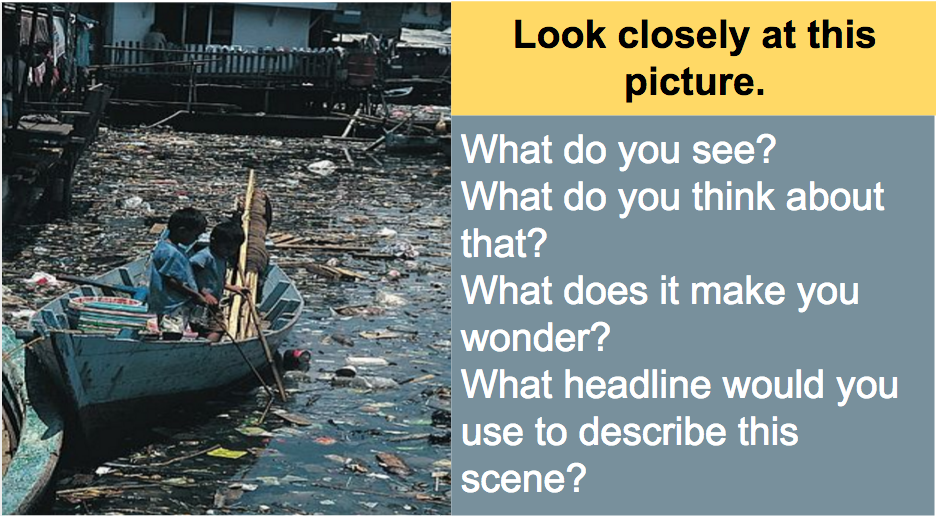
The year 5 & 6 students got the chance to work with Anne Sinclair this week who is an expert in the field of education. They were introduced to the Paideia method which is a way of learning that can provide opportunities for deep dialogic discussions. This process will hopefully improve the communication and critical thinking skills of the students. A set of mini tasks were provided that enabled students to work in small groups and to think about the issues surrounding a statement or image.

This was one example:


Students were expected to think, talk with others and provide reasons for their thinking. They had to justify their thinking and needed to be able to communicate their ideas with others. They also learnt how to listen and respond effectively, as well as how to disagree agreeably. During this task I noticed that some students were more vocal than others. A few would dominate most of the conversations and the majority seemed to hold back and were reluctant to share their ideas. The next step would be to find ways to encourage the others to participate and share their thoughts. So far the activities have been interesting, but I would like to see other students gaining the confidence to speak their mind.

Tuesday, 14 February 2017

Deep Dialogic Discussions - Paideia Practice Task

This movie shares some highlights from one of the Paideia practice tasks that the students had to work on. Anne Sinclair (teacher mentor) facilitates the discussion and guides the students through the process of learning how to have deep dialogic discussions (Paideia method). Students take turns to talk about a subject and explain why they think the way they do. The other students practice listening and responding to what is being said. Prior to the discussion taking place, students were presented with a list of issues. They had to decide on which issue was the most important for them to focus on immediately. Many students were hesitant to share their ideas and it was clear that a few students tended to dominate the discussion.


Paideia 14 Feb 17 from SchoolTV on Vimeo.